
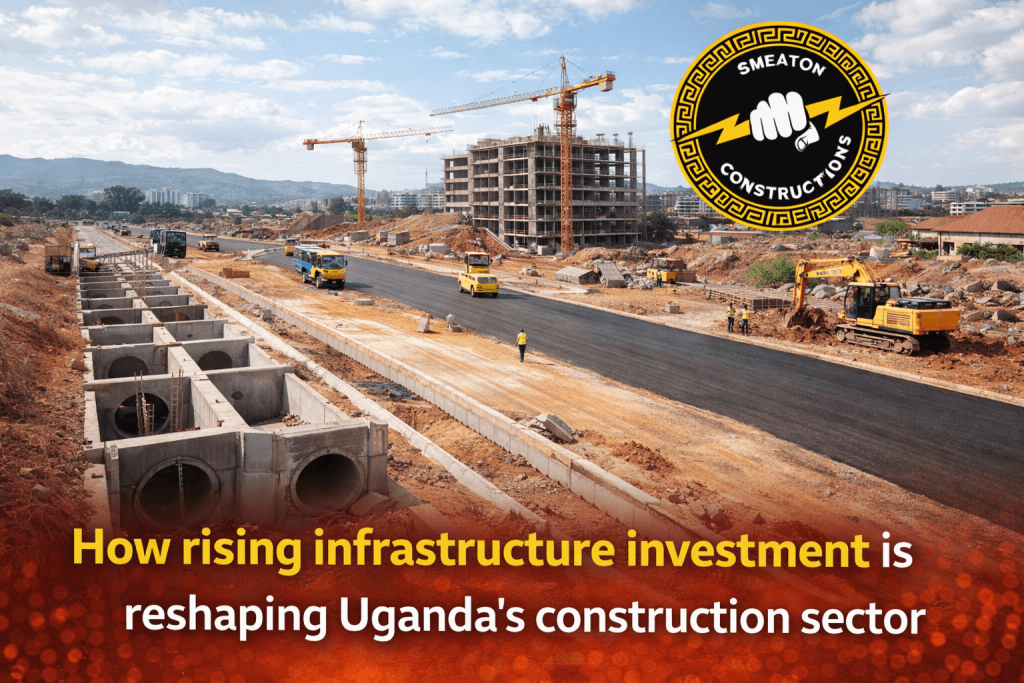
Across Uganda, public and private infrastructure investment is transforming how the construction industry operates.
New transport corridors, urban upgrades, energy facilities and large public developments are changing not only skylines — but also skills demand, project delivery standards and business opportunities.
At Smeaton Constructions, this shift is clearly visible in how projects are planned, delivered and supported with modern construction systems.
Infrastructure spending is driving steady project pipelines
Large infrastructure programmes are creating consistent work across:
- road and transport infrastructure
- drainage and flood-control systems
- urban redevelopment schemes
- public buildings and utilities
This steady pipeline allows contractors and suppliers to plan better, invest in equipment and build long-term teams instead of operating only on short projects.
-
2-Bedroom House Plan
Original price was: $ 300.$ 250Current price is: $ 250. -
2-Bedroom House Plan Modern Residential Design
Original price was: $ 300.$ 250Current price is: $ 250. -
3 Bedroom Bungalow House Plan
Original price was: $ 300.$ 250Current price is: $ 250.



Strong demand for skilled construction professionals
Rising investment is pushing the industry to raise technical standards.
There is increasing demand for:
- engineers and site supervisors
- skilled technicians and artisans
- project managers and safety officers
- surveyors and quality inspectors
Developers are now prioritising trained teams that can meet tighter timelines and quality requirements.
Modern project delivery methods are becoming necessary
Large infrastructure projects require more organised delivery systems.
This is leading to wider adoption of:
- structured project scheduling
- digital documentation and reporting
- coordinated subcontractor management
- professional procurement and logistics systems
Construction is shifting from informal site management to structured and accountable project delivery.
Urban growth is accelerating building activity
Infrastructure investment is stimulating rapid development in:
- residential estates
- commercial buildings
- mixed-use developments
- supporting service facilities
Once roads, drainage and utilities are improved, private developers follow quickly.
This creates strong demand for building contractors, designers and material suppliers.
Improved standards for safety and compliance
Public and donor-funded projects are setting higher expectations.
Developers are now expected to follow:
- stronger site safety systems
- documented quality assurance procedures
- environmental protection requirements
- structured inspections and reporting
This is raising professionalism across the entire sector.
New opportunities for local contractors
Rising infrastructure investment is creating opportunities for:
- subcontractors and specialist installers
- local material suppliers and manufacturers
- transport and logistics providers
- professional service consultants
Smaller companies that meet compliance and quality requirements can now participate in larger, structured projects.
Stronger supply chains and material demand
Large-scale infrastructure works increase demand for:
- cement and aggregates
- steel and reinforcement products
- finishing materials and fittings
- specialised construction equipment
This is improving supplier networks and encouraging better inventory planning and organised delivery systems.
Technology is becoming part of daily construction work
To manage complex infrastructure projects, technology is now widely used for:
- progress tracking
- cost monitoring
- drawing coordination
- reporting and approvals
Digital tools improve transparency and reduce errors between design, site and management teams.
What this means for the future of Uganda’s construction sector
Rising infrastructure investment is building a more professional and competitive industry.
The sector is benefiting from:
- higher quality expectations
- stronger workforce development
- improved project reliability
- better collaboration between public and private players
Construction is no longer driven only by individual buildings, but by long-term national development planning.
Final outlook
Infrastructure investment is reshaping Uganda’s construction sector into a more organised, skilled and opportunity-driven industry.
For contractors, developers and suppliers, adapting to higher standards and modern delivery systems is now essential for sustainable growth.