
A Major Step for Regional Trade, Infrastructure and Construction Growth
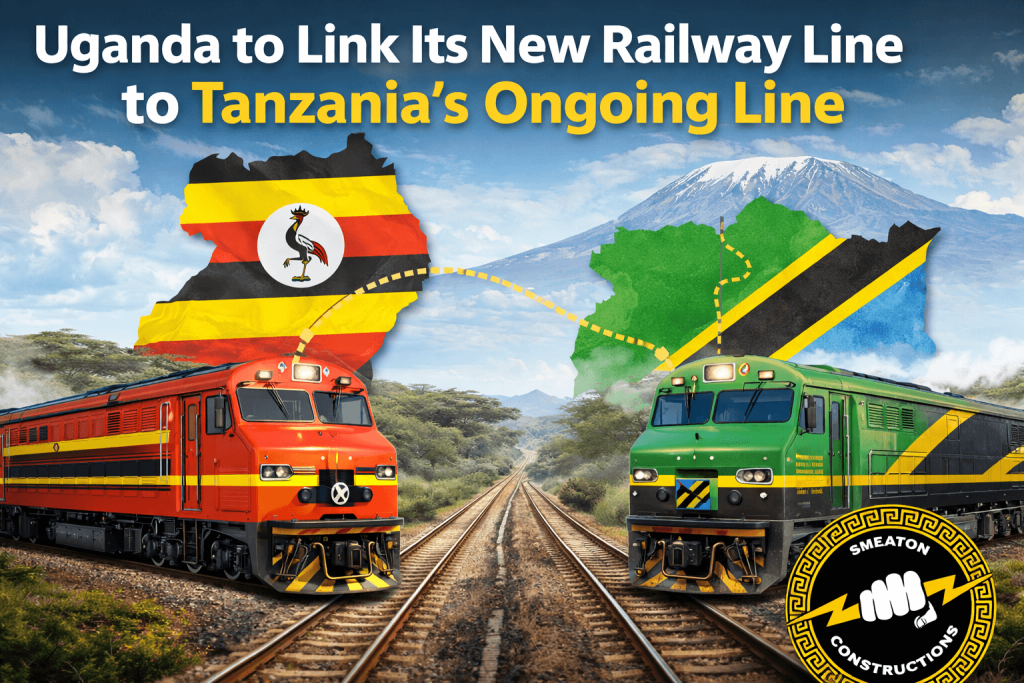
Uganda has announced plans to connect its new railway line to the railway project currently under construction in neighboring Tanzania.
This strategic move is expected to significantly improve cross-border transport, strengthen trade corridors and unlock new opportunities for infrastructure development across Uganda.
The planned connection will bring Uganda’s modern railway network into direct alignment with Tanzania’s fast-developing rail system, creating a stronger and more efficient regional transport backbone.
A coordinated regional infrastructure vision
The proposed railway linkage is being coordinated through national railway authorities, including Uganda Railways Corporation and Tanzania Railways Corporation.
By aligning technical standards, route planning and operational systems, both countries aim to ensure seamless train movement across borders.
This approach reduces logistical delays and helps to create a single, continuous rail corridor serving the wider East African region.
Why the railway connection matters for Uganda
For Uganda, the new rail link is more than a transport upgrade. It is a long-term economic and construction strategy.
In particular, the project will:
- improve movement of construction materials such as cement, steel and aggregates,
- lower transport costs for large infrastructure and housing projects,
- support faster delivery of public works and private developments, and
- enhance access to regional ports through Tanzania.
As a result, contractors and developers will be able to plan larger and more time-sensitive projects with greater certainty.
Boosting trade and industrial development
A connected railway corridor will strengthen supply chains for:
- manufacturing zones,
- industrial parks, and
- agricultural processing centers.
This railway integration also supports regional cooperation under the wider development framework of the East African Community, which promotes infrastructure harmonization among member states.
For Uganda, this means improved competitiveness of locally produced goods and better access to international markets through Tanzania’s transport network.
Construction sector impact and new project opportunities
The railway linkage will directly stimulate Uganda’s construction sector.
In addition, new demand will emerge for:
- railway stations and terminals,
- bridges and drainage systems,
- access roads and logistics yards, and
- commercial and residential developments around transport hubs.
Moreover, engineering firms, civil contractors and building suppliers are expected to benefit from sustained infrastructure spending over several years.
Skills development and employment growth
Large-scale railway construction creates a strong multiplier effect for employment.
Thousands of skilled and semi-skilled workers are required for:
- earthworks and structural construction,
- electrical and mechanical installations, and
- maintenance and operational facilities.
At the same time, local professionals gain exposure to modern railway engineering standards, strengthening Uganda’s long-term technical capacity.
How Smeaton Constructions aligns with this national vision
At Smeaton Constructions, we closely follow national infrastructure policies and regional development programmes.
Our approach supports this railway expansion by:
- preparing for increased demand in civil works and structural construction,
- adopting compliant engineering and site-management practices, and
- promoting modern building standards for projects located along emerging transport corridors.
As transport connectivity improves, new residential, commercial and industrial developments become viable.
Smeaton Constructions is committed to delivering reliable and well-planned construction solutions that support Uganda’s infrastructure-led growth.
Looking ahead
The decision by Uganda to link its new railway line with Tanzania’s ongoing railway project marks a major milestone for regional connectivity.
Most importantly, it positions Uganda for:
- stronger regional trade,
- improved logistics efficiency, and
- long-term construction sector expansion.
This railway integration is not only a transport project.
It is a foundation for future cities, industries and modern infrastructure across Uganda.
BUY YOUR DREAM HOUSE PLAN NOW
-
2-Bedroom House Plan
Original price was: $ 300.$ 250Current price is: $ 250. -
2-Bedroom House Plan Modern Residential Design
Original price was: $ 300.$ 250Current price is: $ 250. -
3 Bedroom Bungalow House Plan
Original price was: $ 300.$ 250Current price is: $ 250. -
3 Bedroom Contemporary House Plan
Original price was: $ 300.$ 250Current price is: $ 250.